
Canada’s Strategy for Large-Scale Infrastructure Projects and the Evolving Role of Dispute Resolution
Reflections from the ICC Canada Arbitration Committee Annual Conference 2026
On October 8, 2026, the ICC Canada Arbitration Committee Annual Conference took place in Montréal, Québec bringing together legal practitioners, arbitrators, and industry professionals from all over the world to discuss emerging developments in international arbitration and dispute resolution.
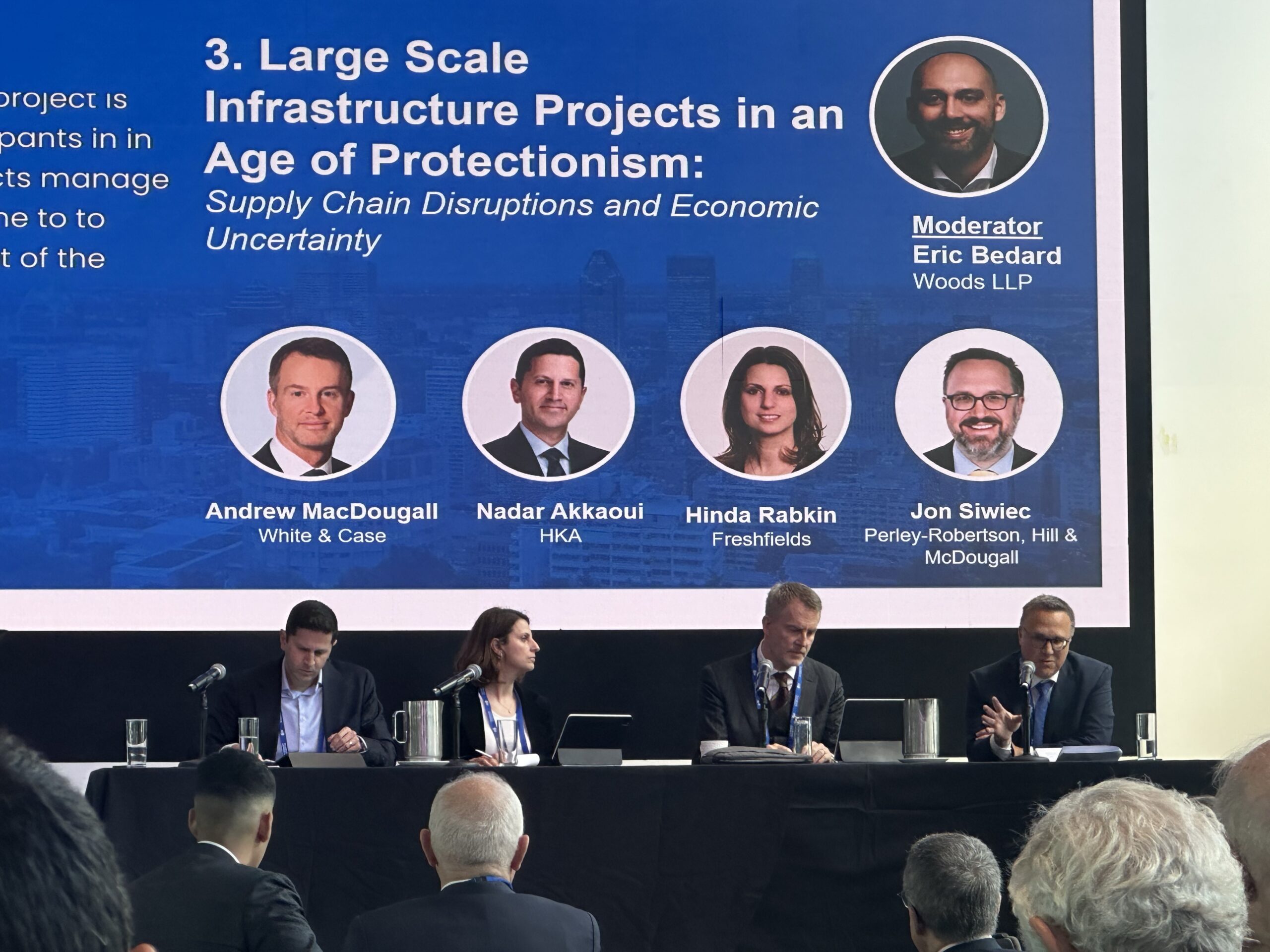
Among the topics explored at the conference was “Large-Scale Infrastructure Projects in an Age of Protectionism: Supply Chain Disruptions and Economic Uncertainty,” a panel moderated by Eric Bedard (Woods LLP), featuring, Andrew McDougall (White & Case LLP), Hinda Rabkin (Freshfields LLP), and Nader Akkaoui (HKA), and John Siwiec (Perley-Robertson, Hill & McDougall LLP). The discussion examined how evolving geopolitical tensions, trade restrictions, and economic uncertainty are reshaping the development and execution of major infrastructure projects.
The discussion was particularly timely from a Canadian perspective. Against the backdrop of increasing trade tensions with the United States, Canada has been pursuing an ambitious strategy aimed at attracting investment, accelerating major infrastructure projects through Bill C-39 otherwise known as the Build Canada Strong Act, and strengthening its economic resilience.
From an American perspective, the Build America, Buy America Act, signed into law by President Biden on November 15, 2021, establishes domestic sourcing requirements for iron, steel, manufactured products, and construction materials used in federally funded infrastructure projects, raising important considerations for Canada–U.S. trade relations today.
Meanwhile, the European perspective highlighted the region’s geopolitical challenges, particularly the ongoing war in Ukraine and tensions in Eastern Europe, as well as the varying pace at which European countries have responded to evolving geopolitical and economic pressures.
While the panel examined the challenges and developments shaping large-scale infrastructure projects across North America and Europe, this article will focus primarily on the Canadian perspective.
In particular, there are three important ongoing developments relevant to Canada: (1) the country’s evolving approach to major infrastructure investment; (2) the contractual mechanisms being adopted to address tariff-related risks; and (3) the increasing importance of dispute prevention and resolution during the lifecycle of infrastructure projects.

Canada’s Response to a Changing Geopolitical Landscape
As geopolitical tensions and protectionist trade policies continue to reshape international commerce, Canada has increasingly focused on strengthening domestic infrastructure and diversifying its economic relationships.
This shift has been reflected in several recent federal initiatives.
At the Canada Investment Summit held in Toronto in September 2026, Prime Minister Mark Carney emphasized Canada’s ambition to attract international capital and accelerate investment in Canadian businesses and infrastructure. The government highlighted nearly $500 billion in announced investments and introduced additional tax incentives intended to improve Canada’s competitiveness.
Among these measures was the proposed Productivity Mega Deduction, building on earlier investment incentives by expanding the range of eligible assets, including transportation infrastructure, energy infrastructure, machinery, and technology.
Another significant development has been the establishment of the Major Projects Office, intended to accelerate the approval and development of infrastructure projects considered to be in the national interest.
However, one of the most notable legislative developments was Bill C-39, the Build Canada Strong Act, introduced on September 21, 2026.
The proposed legislation seeks to streamline federal approval processes for major infrastructure projects, including through a one-year federal review objective and the creation of designated regions of national interest.
These proposed reforms reflect an effort to reduce regulatory uncertainty and accelerate infrastructure development while maintaining environmental protections and the Crown’s constitutional duty to consult Indigenous Peoples.
Importantly, the legislation also raises broader questions about how governments can balance economic competitiveness, regulatory efficiency, environmental responsibilities, and Indigenous rights.
Protectionism and the Changing Allocation of Contractual Risk
Beyond government policy, protectionist measures are directly affecting the contractual relationships underlying major infrastructure projects.
For Canadian contractors and project owners, tariffs on imported materials and equipment can result in increased construction costs, supply-chain disruptions, and uncertainty surrounding project timelines.
These challenges raise an important contractual question: Who should bear the financial consequences when tariffs or trade restrictions materially increase the cost of completing a project?
One mechanism discussed was the use of a Tariff Cash Allowance, which can be incorporated into construction contracts to address extraordinary tariff-related costs and trade delays.
Such an allowance provides a defined contractual framework for allocating certain additional costs arising from specified trade measures. Depending on the contractual language, contractors may be required to substantiate claims through supporting documentation, with costs exceeding the allowance remaining their responsibility.
Other contractual mechanisms may include change-in-law provisions, price-escalation clauses, and provisions addressing changes in taxes or duties.
The discussion underscored the importance of anticipating geopolitical risks at the contract-drafting stage rather than attempting to resolve them only after a dispute arises.
Dispute Prevention and Resolution in Major Infrastructure Projects
A final consideration is how parties and dispute-resolution institutions are adapting to these emerging challenges.
Large-scale infrastructure projects frequently involve multiple stakeholders, complex contractual relationships, and significant financial commitments. When disputes arise during construction, lengthy litigation or arbitration proceedings can create additional uncertainty and potentially disrupt project delivery.
Consequently, there is increasing emphasis on mechanisms capable of addressing disputes while projects remain ongoing.
These include the appointment of independent cost consultants to assess tariff-related claims, the early involvement of project mediators, and the growing use of interim adjudication.
In Ontario, adjudication under the Construction Act has become an increasingly important mechanism for resolving certain construction disputes on an expedited basis.
There is a growing use of adjudication administered by Ontario Dispute Adjudication for Construction Contracts (ODACC), reflecting the practical importance of mechanisms that permit projects to continue while disputes are addressed.
An adjudicator’s determination is binding on an interim basis, subject to final resolution through litigation or arbitration.
This distinction is particularly important for large infrastructure projects, where preserving cash flow and maintaining construction progress can be just as significant as ultimately determining the parties’ legal rights.
Looking Ahead
The panel offered an important perspective on the relationship between geopolitics, infrastructure development, and dispute resolution.
Canada’s response to increasing protectionism is not limited to trade policy. It extends to the regulatory frameworks governing major projects, the contractual allocation of economic risks, and the dispute-resolution mechanisms available when those risks materialize.
For legal practitioners, these developments underscore the importance of understanding not only the legal frameworks governing infrastructure projects but also the broader geopolitical and commercial realities in which those projects operate.
As Canada seeks to accelerate infrastructure development and attract investment in an increasingly uncertain global environment, effective contractual risk allocation and timely dispute resolution will be essential to the successful delivery of major projects.